Welcome: Jiangsu Hongjing Metal technology Co.,Ltd







yolanda@hongjingmetal.com +86-15358997067

Bearing overheating is one of the most recurring failure modes for precision crossed roller bearings used in robot joints, CNC rotary tables, semiconductor machinery and automation rotary units. Unlike standard ball bearings, crossed roller bearings carry combined radial, axial and tilting‑moment loads. Even minor mis‑selection or installation errors can trigger overheating, excessive torque, raceway damage and unexpected machine downtime.
Many field failures start with abnormal temperature rise. If left unaddressed, overheating will accelerate grease degradation, cause roller and raceway scoring, and eventually lead to permanent bearing damage. Engineers often ask: why does my crossed roller bearing get hot quickly? What causes cracking or uneven wear on crossed roller bearings? Below we break down real‑world root causes, failure symptoms and actionable improvement measures.
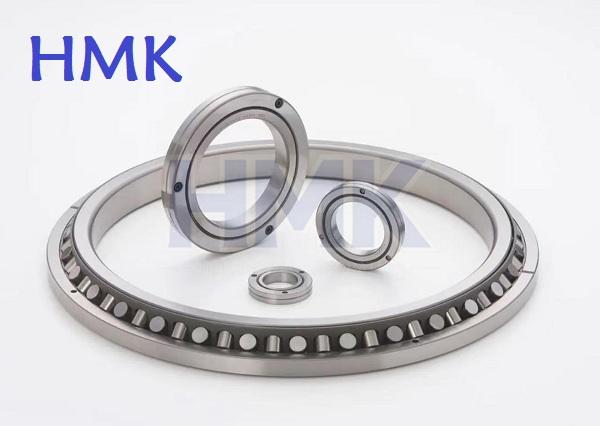
Common Root Causes of Crossed Roller Bearing Overheating & Damage
1. Incorrect preload setting
This is the top‑reported issue among automation OEMs. Too‑heavy preload creates excessive internal friction, raising operating temperature and shortening grease service life. Too‑light preload leads to internal clearance, positional drift and uneven roller loading. Both conditions result in overheating and premature wear.
2. Improper installation & mounting surface defects
Crossed roller bearings are highly sensitive to flatness and perpendicularity. Poorly machined mounting faces, uneven bolt tightening torque or violent installation will create edge loading on rollers. Localized stress generates heat, and can produce raceway cracks from overload impact. Even small dimensional deviations can trigger continuous temperature rise.
3. Grease selection and lubrication problems
Using wrong grease type, insufficient grease fill, or contaminated lubricant will cause high‑temperature operation. Dust, metal chips and coolant contamination break down grease quickly. Sealed‑UU‑type bearings can prevent foreign‑particle ingress, but over‑greasing also causes overheating.
4. Wrong series selection and mismatched rotation mode
Many buyers match dimensional size only, ignoring rotation direction. Running RB‑series bearing for outer‑ring rotation or RE‑series for inner‑ring rotation creates abnormal friction and heat buildup. Mismatched series leads to abnormal wear, vibration and overheating.
5. Overload and cyclic fatigue operation
Continuous overload or repeated heavy tilting‑moment loads accelerate material fatigue. Uniform wear across raceways indicates long‑term fatigue operation. Repeated shock loads produce micro‑cracks on raceways, which expand under heat and operation until bearing failure.
Typical Failure Symptoms
• Abnormal temperature rise during running, grease discoloration or leakage
• Increased rotary torque, vibration and positioning drift
• Uneven raceway wear from fatigue; cracks generated by impact or improper mounting
• Noise during rotation, reduced repeat positioning accuracy
Practical Improvement Measures to Reduce Crossed Roller Bearing Failures
These actionable steps can resolve repeated bearing damage and extend service life.
1. Optimize preload configuration
Select preload level according to your rigidity requirement, do not copy catalog values blindly. Match preload to actual moment and radial‑axial load conditions.
2. Strictly control installation quality
Ensure mounting surface flatness and perpendicularity. Apply uniform bolt torque sequence. Avoid hammering or violent assembly. Inspect mounting faces before bearing fitting.
3. Correct lubrication management
Choose high‑quality grease suitable for crossed roller bearings. Avoid over‑greasing. For harsh environments, adopt UU sealed bearings to block dust and coolant. Periodically inspect lubricant condition.
4. Double‑check series and rotation mode match
Confirm whether your application requires inner‑ring or outer‑ring rotation before ordering. Select RB for inner‑ring rotation, RE for outer‑ring rotation, RU/CRBH for dual‑rotation scenarios.
5. Avoid overload and shock loads
Keep working loads within rated load limits. Add shock‑absorbing design if equipment is subject to frequent impact. Monitor operating temperature in long‑run cycles.
Application‑oriented summary
Crossed roller bearing overheating rarely comes from poor raw‑material quality alone. Most failures stem from wrong preload, bad installation, improper lubrication or series mis‑selection. Implementing the above improvement measures can greatly cut unexpected downtime, improve rotary positioning stability, and lower long‑term replacement costs.
If you encounter repeated overheating or failure of your rotary unit, our engineering team can review your application parameters and provide bearing‑selection recommendations.
Contact: Yolanda
Phone: +86-15358997067
E-mail: yolanda@hongjingmetal.com
Add: No.88, Qianyao Road, Binhu District, Wuxi, China
LiveChatclose
 Send Email
 Skype
Skype WhatsApp