Welcome: Jiangsu Hongjing Metal technology Co.,Ltd







yolanda@hongjingmetal.com +86-15358997067
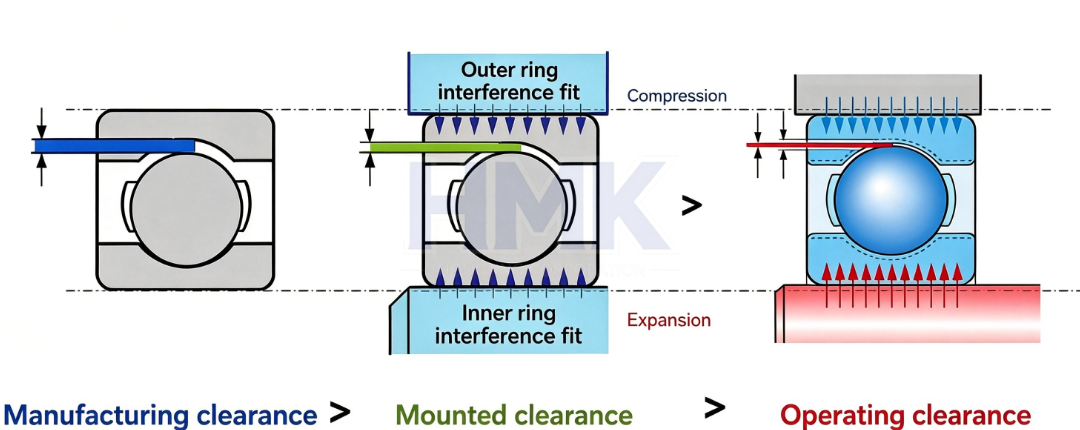
Bearing internal clearance is one of the most critical parameters that directly affects bearing noise, vibration, heat generation, service life, and operating stability.
Many equipment failures, including abnormal noise, premature wear, and bearing seizure, result from incorrect clearance class selection.
ISO standard defines five mainstream radial clearance classes for rolling bearings: C2, CN (Normal), C3, C4, and C5. The clearance increases sequentially from C2 to C5.
Most standard bearings adopt CN clearance by default without special marking, while C2, C3, C4, and C5 are specially customized for specific working conditions.
This article systematically compares all bearing clearance classes, clarifies their characteristics, applicable scenarios, and selection principles, helping global buyers and engineers select matching bearings for different industrial applications.
What Is Bearing Internal Clearance?
Bearing internal clearance refers to the movable distance between the inner ring, outer ring, and rolling elements when the bearing is not installed and under no load.
After bearing installation and operation, factors including interference fit, temperature rise, and mechanical pressure will change the original clearance.
Proper reserved internal clearance ensures the bearing can operate smoothly, compensate for thermal expansion, and avoid excessive friction.
Full Comparison of Bearing Clearance Classes (C2 / CN / C3 / C4 / C5)
1. C2 Clearance (Smaller Than Normal)
C2 is a tight clearance class smaller than standard CN clearance. It features minimal internal movement and ultra-low vibration.
Core Features
• Tightest standard clearance
• Low noise and slight runout
• Strict requirement for installation fit and operating temperature
Applicable Scenarios
High-precision, low-speed, and temperature-stable equipment, including precision instrumentation, miniature motors, office automation equipment, and precision transmission parts. Ideal for scenarios requiring extremely smooth operation and zero abnormal vibration.
2. CN Clearance (Normal / Standard)
CN clearance, also called normal clearance, is the default standard for most conventional bearings. No suffix marking is required for CN bearings in general models.
Core Features
• Standard medium clearance
• Balanced performance of noise, wear resistance and stability
• Adaptable to room temperature and common transition fit
Applicable Scenarios
Universal general-purpose equipment under conventional working conditions. Widely used in ordinary mechanical transmission, household appliances, conventional pumps, and general industrial machinery with normal speed and temperature.
3. C3 Clearance (Larger Than Normal)
C3 is the most popular customized clearance in the industrial field, larger than standard CN clearance.
Core Features
• Extra reserved clearance for thermal expansion
• Effectively avoids bearing locking after temperature rise
• Compatible with tight shaft interference fit
Applicable Scenarios
High-speed and high-temperature operating equipment, such as industrial electric motors, high-speed fans, automobile parts, and industrial pumps. It compensates for inner ring thermal expansion and fit extrusion deformation during high-speed operation.
4. C4 Clearance (Larger Than C3)
C4 clearance is further enlarged on the basis of C3, reserved for harsh working conditions with severe deformation and heat generation.
Core Features
• Large internal space allowance
• Strong adaptability to heavy interference fit
• Excellent thermal expansion compensation capability
Applicable Scenarios
Heavy-duty industrial machinery with high load, high speed, and severe temperature rise, including construction machinery, mining equipment, large gearboxes, and heavy-duty motor devices.
5. C5 Clearance (Maximum Standard Clearance)
C5 is the largest standard bearing clearance class, designed for extreme harsh industrial environments.
Core Features
• Maximum reserved internal clearance
• Strong tolerance for mechanical deformation and extreme temperature changes
Applicable Scenarios
Ultra-high speed, ultra-high temperature, and heavy-load special equipment, large industrial rotary equipment, and customized industrial machinery with extreme working conditions.
How to Select the Right Bearing Clearance?
1. Select C2 for:
Precision equipment, low-speed stable operation, strict noise control, and room-temperature installation without tight interference fit.
2. Select CN for:
Conventional general machinery, normal speed, normal temperature, and standard assembly environment (preferred default choice).
3. Select C3 for:
Most industrial motors, high-speed rotating parts, equipment with obvious temperature rise, and bearings with tight shaft fit.
4. Select C4 / C5 for:
Heavy load, ultra-high speed, severe thermal expansion, and heavy interference assembly scenarios.
Common Customer FAQ
Q1: Why do motor bearings mostly use C3 clearance?
Motor bearings generate continuous friction heat during high-speed rotation. C3 extra clearance reserves space for thermal expansion, preventing bearing jamming, excessive friction, and premature burnout.
Q2: Is larger clearance always better?
No. Excessively large clearance will cause bearing vibration, noise, and unstable rotation. Tight clearance suits precision operation, while loose clearance adapts to high temperature and high speed. Matching working conditions is the core of selection.
Q3: Why are CN bearings unmarked?
CN normal clearance is the industry default standard. Manufacturers do not add suffix marks for conventional CN bearings to simplify model specification.
Conclusion
Bearing clearance class directly determines the operating performance and service life of industrial bearings.
C2 for precision stability, CN for universal use, C3 for high-speed motor equipment, and C4/C5 for heavy-duty extreme working conditions.
Correct clearance selection eliminates 80% of conventional bearing operating faults.
If you have customized working conditions, our professional team can provide accurate bearing clearance matching and one-stop customized solutions.
Related Articles
• Learn about ABEC tolerance classes to match precision grades with clearance grades.
• Check sealed vs shielded bearing types to optimize bearing protection for different environments.
Contact: Yolanda
Phone: +86-15358997067
E-mail: yolanda@hongjingmetal.com
Add: No.88, Qianyao Road, Binhu District, Wuxi, China
LiveChatclose
 Send Email
 Skype
 WhatsApp