Welcome: Jiangsu Hongjing Metal technology Co.,Ltd







yolanda@hongjingmetal.com +86-15358997067
Visual inspection and morphological analysis are the most direct and efficient methods to judge bearing failure types, damage degrees, and root causes. Different surface defects including spalling, rusting, cracking, and uniform wear correspond to distinct mechanical problems, lubrication failures, and environmental factors. Targeted improvement measures can eliminate repeated bearing damage and premature failure thoroughly.
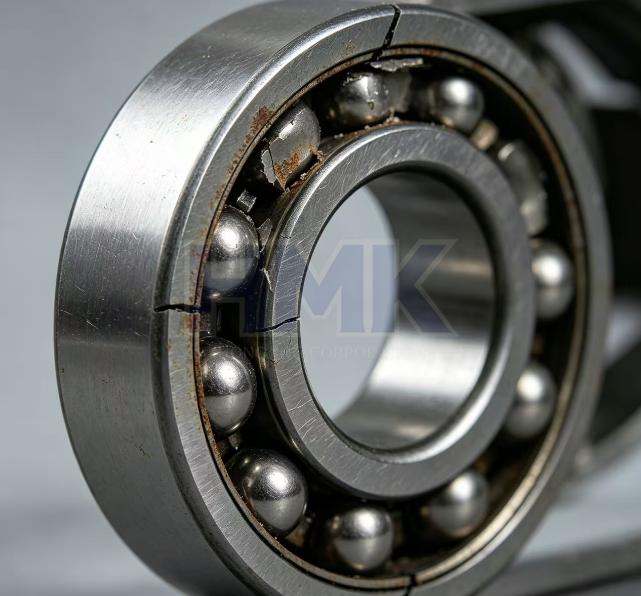
1. Bearing Surface Spalling Failure
Failure Characteristics
Local flaking, pitting, and layer peeling on raceways and rolling element surfaces, with irregular metal falling off.
Root Causes
Bearing spalling is mainly caused by material surface fatigue and insufficient lubrication protection. Long-term cyclic alternating load produces micro-fatigue inside the metal structure. When the lubricating oil film is incomplete or invalid, direct friction accelerates surface metal fatigue, forming micro-pits that gradually expand into large-area spalling. Impact load and vibration operation will aggravate this failure.
Improvement Measures
Use high-precision bearings with excellent fatigue resistance; implement standardized lubrication cycles to maintain complete oil film isolation; reduce frequent impact and vibration load during equipment operation.
2. Bearing Rust Corrosion Failure
Failure Characteristics
Oxide spots, rust patches, and rough corrosion layers appear on bearing inner rings, outer rings, rolling elements, and cages.
Root Causes
Bearing rust is triggered by moisture, humid working environment, water vapor invasion, and poor sealing performance. Damaged bearing seals, unprotected storage, humid workshop air, and cooling water leakage will cause surface oxidation and electrochemical corrosion. Rust points destroy the smooth raceway surface, induce friction noise, and accelerate wear.
Improvement Measures
Adopt bearings with high-quality sealing structures (double seals, dust-proof covers); strengthen equipment sealing maintenance; keep storage and working environment dry; apply anti-rust oil and protective packaging for inventory bearings.
3. Bearing Crack Failure
Failure Characteristics
Visible linear cracks on bearing rings or local structural fracture, which may cause sudden bearing breakage during operation.
Root Causes
Bearing cracks are typical mechanical damage failures, mainly from violent installation impact, excessive press-fitting force, severe overload impact, and metal material fatigue. Improper installation tools, forced assembly, and instantaneous heavy impact load will produce internal structural cracks, which expand rapidly under rotating operation.
Improvement Measures
Use professional bearing installation tools to avoid violent knocking and forced assembly; strictly prohibit overload and impact operation; inspect bearings regularly for micro-cracks to replace defective parts in advance.
4. Uniform Bearing Wear Failure
Failure Characteristics
Uniform thinning of raceway and rolling element surfaces, reduced dimensional accuracy, increased clearance, and smooth overall wear traces.
Root Causes
Uniform wear is a typical long-term fatigue aging failure, caused by long-time continuous operation, minor friction loss accumulation, lubricant aging and contamination, and long-term stable load operation. Dust and abrasive particles mixed in the lubricant will accelerate uniform abrasive wear.
Improvement Measures
Replace aging lubricant regularly; filter or update polluted grease; choose high-wear-resistant bearing materials; formulate periodic bearing inspection and replacement plans for long-running equipment.
Conclusion
Each bearing surface failure corresponds to specific equipment defects and improper maintenance habits. Accurate visual failure analysis helps engineers locate root causes quickly. By matching targeted optimization solutions for spalling, rusting, cracking, and wear, factories can completely solve repeated bearing damage, improve mechanical stability, and reduce long-term operational replacement costs.
CLICK HERE FOR MORE PROFESSIONAL GUIDANCE ON BEARINGS
Contact: Yolanda
Phone: +86-15358997067
E-mail: yolanda@hongjingmetal.com
Add: No.88, Qianyao Road, Binhu District, Wuxi, China
LiveChatclose
 Send Email
 Skype
Skype WhatsApp